Brainiact does an outstanding job at assisting clients with their business growth. Very professional, attentive, knowledgeable and tailored services for each individual’s needs. I highly recommend Brainiact and its services.

Where in Australia provides the best odds of success?
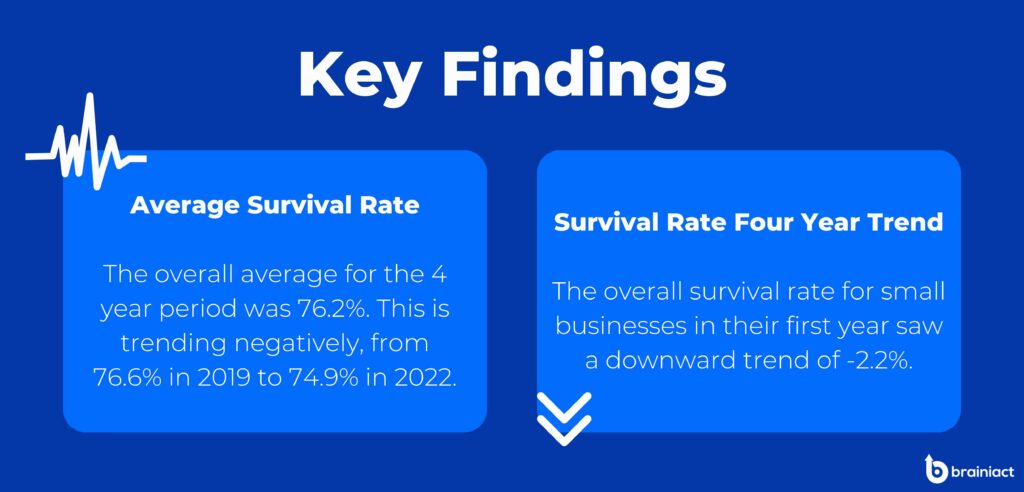
In Australia, the entrepreneurial landscape is challenging. According to the Australian Bureau of Statistics, out of the 365,000 small businesses launched in the 2021 financial year, only 74% made it through their first year. This initial year is critical, with many companies not surviving past it. Fast forward to three years later, and just half of these businesses remain standing.
So, what’s influencing these numbers? Is it the location where a business starts or does industry choice play a role?
This report dives deep into the survival rates of small businesses (those with zero to 19 employees), breaking down where they thrive most across Australian local government areas and industries. Our analysis spans four years (2019-2022), highlighting trends in business longevity and uncovering which industries and regions offer a safer bet for new ventures.
If you’re a business owner determined to beat the odds and grow with confidence, take a look at our business coaching services, designed to help you achieve your unique goals.
In Australia's dynamic business landscape, certain industries have emerged as leaders in resilience, while others face more significant challenges. The Health Care and Social Assistance industry stands out with an impressive 82.7% survival rate. This may be explained by Australia’s ageing population and a rising demand for health services, meaning this sector benefits from steady, long-term demand. Healthcare needs are stable and often prioritised, making these businesses essential and less vulnerable to economic fluctuations.
The Health Care and Social Assistance industry is closely followed by the Agriculture, Forestry, and Fishing industry with a four-year survival rate of 81.7%. As a nation rich in natural resources, Australia’s agriculture sector remains a cornerstone of the economy. Even amid environmental challenges, this industry’s export-oriented model and constant demand for food and resources keep survival rates high.
On the other end of the spectrum, industries like Public Administration and Safety (68%), Transport, Postal and Warehousing (70%), and Administrative and Support Services (72.5%) experience the lowest survival rates. The Transport, Postal, and Warehousing industry also saw the largest drop in survival rates (8%) between 2019 and 2022. This may be because rising fuel costs, global supply chain disruptions, and workforce shortages have intensified pressure on businesses.
Interestingly, the Construction and Manufacturing industries are the only industries to experience a slight increase in survival rates (0.5% and 0.2% respectively). While modest, this growth reflects these sectors’ resilience and role in meeting Australia’s demand for infrastructure and goods. However, the increase may also signify adaptation to evolving technologies and production methods, helping some businesses withstand challenges.
Our research shows that location can make a dramatic difference to business survival rates. Some regional areas showcase exceptional resilience, while major urban centres reveal specific vulnerabilities.
Despite a slight dip over the past four years, Babinda in Cairns tops the survival charts with an impressive average survival rate of 92.8%. This is followed closely by Moree Surrounds in NSW at 90% and Gnowangerup in WA at 89.8%.
In contrast, the majority of areas with the country’s lowest survival rate are in Greater Sydney, with nine of the bottom 12 locations in this region. Sydney’s Bondi Junction and Waverley area ranks second from the bottom at 65.6%. Four suburbs around Parramatta (Berala, South Wentworthville, Merrylands – Holroyd, and Auburn – North), and three suburban areas in Sydney’s South West (Cecil Hills; Liverpool – West; and Ashcroft – Busby – Miller) also rank in the bottom 12. The other three spots in the bottom 12 were from Queensland, including Goodna which ranks last with a survival rate of 63.7%.
Higher survival rates in rural areas may be due to several factors. First, rural areas generally see fewer business start-ups, resulting in lower competition and enabling more businesses to stay afloat. Second, in urban centres, there are usually more job and business options, making it easier – and often more appealing – for owners to exit struggling ventures. Lastly, rural business owners tend to be more conservative with risk, partly due to fewer fallback options.
Australia’s business survival rates reveal a striking contrast between resilient rural areas and more volatile urban centres. Outback South Australia leads with the highest survival rate at 83.4%, followed by Victoria's Warrnambool and South West region (82.4%) and Western Australia’s Wheat Belt (82.2%).
These areas benefit from stable local economies driven by essential industries like agriculture, mining, and regional services. They are also likely to benefit from lower operational costs, close community networks that create a supportive environment for businesses to enjoy steady demand and fewer competitors, bolstering their ability to endure market shifts.
In contrast, urban regions face more significant challenges. Six of the bottom ten areas for survival rates are located in New South Wales, led by Parramatta at 71.6%. Other low-survival areas in Sydney include Blacktown (72.2%), South West (72.2%), Inner South West (72.6%), Outer South West (73.5%), and Inner West (74.2%). Urban areas in Melbourne and Ipswich, Queensland, also show lower survival rates, with Melbourne’s West (72.5%) and North West (72.9%) ranking near the bottom. These metropolitan regions typically contend with high operational costs, intense competition, and evolving consumer preferences that are likely to impact survival.
Over recent years, certain suburbs in Australia have seen remarkable growth in business survival rates, while others have faced steep declines. Stuart Park in Darwin leads with a notable 40.5% increase. This growth is closely followed by McDowall in Brisbane’s North, with a 35.5% increase, and Mandurah South in Western Australia at 33.4%.
Conversely, other suburbs, particularly in Victoria, are experiencing significant challenges. Swan Hill Surrounds (-31.1%), Chelsea Heights (-30%), Burnside (-26.6%), and Clyde North (-25%) have experienced the biggest decrease in survival rate, with South Palmerston seeing the biggest drop of 32.5% in survival rates from 2019 to 2022. These declines could be driven by heightened competition, economic shifts, and rising operational costs that put additional pressure on smaller businesses.
Regional areas like Barossa, York and Mid-North in South Australia have experienced positive shifts in business survival, with a 7% increase over the past four years. The region is followed closely by North Moreton Bay in Queensland at 6%. In contrast, Melbourne's suburban regions face steeper challenges. North West and West Melbourne recorded the most significant declines in survival rates, each with a 9% drop, followed closely by North East Melbourne and the Coffs Harbour and Grafton region (-7%).
Jared Dawson, founder of Brainiact and business coach, comments:
“As our research shows, business survival rates across Australia vary widely depending on industry and location. It’s no surprise that sectors like Health Care and Agriculture lead the way in resilience, reflecting Australia’s unique economic landscape, with high demand for health services and a strong agricultural backbone. Meanwhile, industries like Public Administration and Transport face steep challenges from rising costs, workforce shortages, and market pressures.
“Geography also plays a pivotal role. Regional areas with strong local economies and tight-knit communities tend to fare better in business survival, while urban centres experience the dual pressures of high competition and operational costs. This underscores the importance of choosing the right environment and sector when launching a business.
“For new business owners, I recommend choosing industries and locations with steady demand and building strong community ties from the start. It’s essential to keep your operating expenses low, focus on excellent customer service, and adapt quickly to changes in the market. Success isn’t just about spotting a market opportunity; it’s about creating sustainable growth. Embrace innovation, listen to your customers, and continually refine your approach. Staying resilient means investing in your business’s foundations and being ready to adapt as needed.”
This report utilises custom tables acquired from the Australian Bureau of Statistics (ABS), based on the Counts of Australian Businesses, including Entries and Exits (CABEE) from 2019-2023 to analyse the survival rates of micro and small business entries. This is the latest available data when segmenting to this level of granularity for geography and industry by business size. The data was accessed in October 2024.
For the purposes of this study, the definitions of business size have been taken from the Australian Bureau of Statistics, based on number of employees:
Non-Employing: Non-employing businesses i.e. sole traders and partnerships with no employees.
Micro Business: Non-employing businesses and employing businesses with less than 5 employees.
Small Business: Non-employing and employing businesses with less than 20 employees.
Business Entries include new business registrations, reactivations of cancelled businesses, businesses that have recommenced remitting GST and a small number of units moving out of the profile population.
Business entry survival is defined as a Business that was not present in the previous year, entered the reported year, and continued operating the following year.
For example, 2019 New Business Survival refers to a Businesses that:
a) didn’t exist in 2018,
b) was alive in 2019; and
c) survived to June 2020
Some small values have been subject to perturbation for confidentiality purposes. Analysis on locations at the suburban level (SA2) is inclusive only of those with a minimum of 75 total small business entries in the 2022 financial year. Businesses that operate across multiple locations are only classified to a single geography to prevent double counting. These businesses are included in the Currently Unknown category for the relevant state or territory and have been excluded from the suburban analysis.
Director, JB Graphic Design
Brainiact does an outstanding job at assisting clients with their business growth. Very professional, attentive, knowledgeable and tailored services for each individual’s needs. I highly recommend Brainiact and its services.
Director, Fluxwood Lighting
My Brainiact business coach is a kind and supportive person with a wealth of knowledge and business ideas. They have made a big impact on how I understand and think about pushing my company forward and I am grateful for their constant support and motivation. Thanks, Brainiact!

Director, APM Electrical
Brainiact is professional and friendly with a wealth of business planning and growth knowledge. They have been a constant guide in helping us grow our business and they always go over and beyond offering their time and services. Thank you, Brainiact!

Managing Director, Sydney Premium Plumbing
We were feeling very lost in our business and needed help streamlining and focusing our efforts. Brainiact has been an asset to our business and we saw a change after one session with our business coach. They provide guidance, insight and keeps us on track. I would HIGHLY recommend Brainiact if you are looking to take your business to the next level.

Director, BlackJack Merchandising
I have been able to achieve great results in a very short time. My Brainiact business coach really holds you accountable and that is what I need. They have motivated me to look outside the square and that has really opened up a lot of opportunities for me. Thanks, Brainiact I really like working with you!
Managing Director, Furfaro Architects
I signed up with Brainiact a little over 2 months ago for the development of my Architectural business.
Brainiact are amazing business coaches whose advice and support are not only helping me take my business to the next level but gain the confidence in myself and my business to do so. Being the sole director of my firm, it’s great to have access to my business coach 24/7 as someone to share ideas with, get advice or even have a supportive chat with.
I look forward to continuing working with Brainiact and am excited about where they will help me and my business grow and succeed.
Managing Director, Sydney Premium Plumbing
We are extremely happy with our decision to bring Brainiact on to help grow our business. From day one, they have provided us with practical advice on winning new commercial work – and their methods work! They are always available to chat and are an excellent sounding board whenever we have any issues we are not sure how to tackle.
Managing Director, Diab's Cleaning Services
We signed up with Brainiact about a month ago and I can honestly say it was the best decision we’ve ever made.
Brainiact has provided us with an incredible business coach, whose great advice is helping us take our business to the next level. We’ve been able to identify some areas that need to be improved. Their great advice is helping us achieve our business goals but most importantly to have a business owner mindset.
Thank you, Brainiact.

Managing Director, Clickhouse
I did Brainiact’s coaching earlier this year and it was the best investment I have ever made. Not only was my coach a highly skilled and experienced business coach, but they were also a genuine person who I really bonded with on a personal level. They helped me transform my business from a struggling, overworked sole trader – to a company with direction, purpose and most importantly a plan. With Brainiact’s guidance, I was able to map out a clear path to growth and diversification. I would hands down recommend Brainiact to anyone in business who wants to get to the next level but just isn’t sure how. A million thanks from a very happy customer and friend!

Director, The Gender Voice Centre
Brainiact provided me with strategies to help my business that could be implemented straight away. When we first got started, only a few months ago, I was overworked and stuck in my business. After crunching numbers and finding a strategy, I now don’t work “in” the business at all, but rather 100% “on” the business. This has allowed me to earn more money, get my health back in order, and spend more time with my daughter. Thank you, Brainiact!

Director, Prime Refrigeration
What a great business decision it was to team up with Brainiact in March 2022.
Brainiact genuinely wants to see our business grow just as much as we do and offers support 24/7. No matter the time or day, contacting my Brainiact business coach always feels comfortable. They are friendly, professional and have a wealth of knowledge and have been a valuable part of our business growth.
Brainiact has been guiding and supporting us every step of the way and we are seeing positive changes already.
Highly recommend! Thanks, Brainiact.

Director, Elevated Plumbing
A MUST FOR COMPANIES IN HARDSHIP.
I engaged with Brainiact 2 months ago. What can I say, the entire process from introduction to business coaching has been phenomenal.
My Brainiact business coach not only has extensive knowledge in business and sales, but their ability to dissect issues and effectively rectify them is also something I can 100% vouch for. Brainiact has helped me increase my sales and given me the knowledge to improve my sales skills, managing staff and given me a different perspective on business as a whole. A great company that will go the extra mile to ensure you are getting everything out of the process. Brainiact has been a diamond in the rough and engaging with them has been the best investment for my business. Worth its weight and gold!

Director, SwitchSafe Electrical Group
Signing up with Brainiact was the best business decision I’ve made. For a first-time business owner, it is very easy to become overwhelmed, stuck or just not know what your next step should be!
I signed up with Brainiact when I was just starting the business, still working full-time for an employer and had a plan to be self-employed with no strategy on how to get there. My Brainiact business coach listened to my goals and then quickly put in place a plan to achieve them. Fast-tracking my business to a point that I can be self-employed!
If you are a business owner, regardless of how long you have been in business. I urge you to talk with Brainiact and get them on board. They provide outstanding service from the very first day and their knowledge will help your business thrive and grow.

Director, Golden Prairies
We signed up with Brainiact about seven months ago to help us improve our business.
We’re so happy with Brainiact. Our Brainiact business coach is a very friendly, professional and knowledgeable person who will put you on the right track and help you grow your business while holding you accountable for your actions.
Highly recommended for business owners who want to take their business to the next level.
